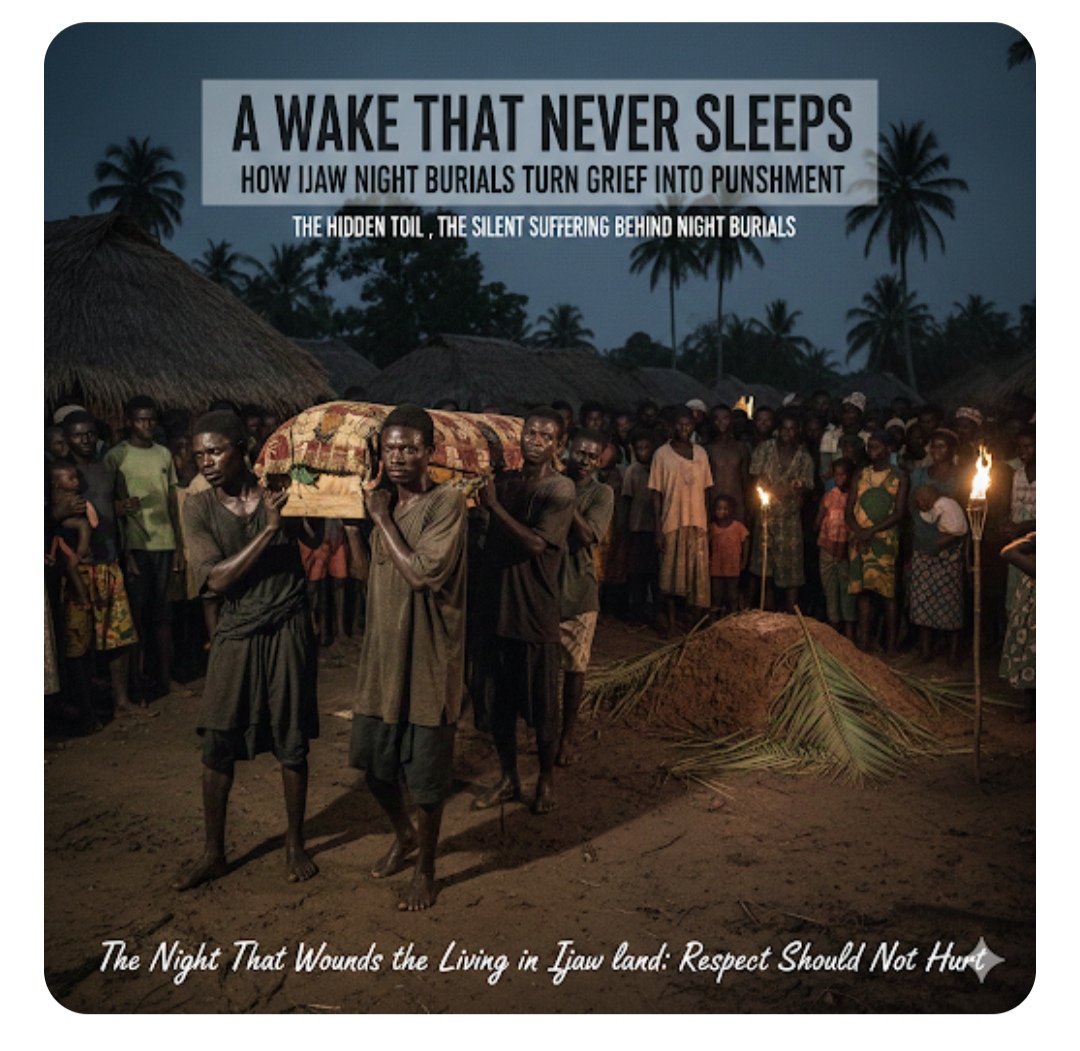
“The Night That Wounds the Living in Ijaw land: Respect Should Not Hurt.”
By Ebikabowei Kedikumo,
Ayakoromo Town, Delta State.
Night falls
and we drag the dead into its arms,
not with candles of mercy,
but with loudspeakers and plastic chairs,
with drinks , food,
with tired bodies and stolen sleep.
In Ijaw land,
the celebration waits for the moon,
not the sun.
The arena is decorated
The food cooked,
The drinks bought,
and we call it honour,
we call it custom,
but the night groans under our choices.
Old men of sixty-plus,
their bones already whispering for rest,
are forced to sit on hard chairs,
eyes burning like dry firewood,
hearts beating slowly like tired drums.
They sit there,
afraid to leave,
afraid of names they will be called
if they dare choose sleep over custom.
For if the grey-headed man
does not attend the night burial,
tongues will rise like smoke.
They will say he is wicked,
they will say he did not care,
some will even point their fingers,
quietly, in corners,
and say, “Maybe he is the one
who killed the dead.”
So he sits,
his body begging for a bed,
his spirit begging for peace,
while the clock crawls past midnight,
then one, then two, then three,
stretching the night like a long rope
around his fragile bones.
The young ones too
are not safe in this dark festival.
Girls hardly grown
slip into shadows
with men whose names they do not know.
Married women laugh too loudly,
touch too freely,
as the darkness covers
what daylight would never allow.
The night that should cradle sorrow
becomes a market of wandering hands
and restless desires.
You see guests dozing on plastic chairs,
heads hanging like broken branches,
mouths open,
dreams fighting with noise.
Their backs ache,
their legs swell,
their minds drift in and out of sleep,
yet they must stay,
chained by fear of gossip
and the cruel judgment of relatives.
By morning,
the body is a battlefield.
Eyes are red like hot coals,
joints scream with hidden pain,
the heart beats uneven rhythms of protest.
The next day is wasted,
the farmer cannot farm,
the trader cannot trade,
the elder cannot think straight.
A single night burial
steals the strength of many days.
Night burial is
a load we place
on backs already bending.
We call it respect,
but it is often suffering
in a fine wrapper.
Night burial is
a custom we fear to question.
We follow it like blind people
holding each other’s clothes,
afraid to say,
“This road is hurting us.”
Night burial is
a thief of rest.
It climbs into our homes
and steals our sleep,
leaving our bodies empty
and our minds slow and dull.
Night burial is
a fire we keep feeding
because our fathers lit it long ago.
We do not ask
if the fire still gives us warmth,
or if it only burns our skin.
Night burial is
a story we can rewrite.
We can choose the morning,
when the sun is kind,
when eyes are clear
and hearts are steady.
We can choose a time
when grief is shared in peace,
not in noise and secret darkness
Night burial is
not the only way
to show love for the dead.
Respect is not in how long we sit,
or how late we stay awake,
but in how gently
we carry one another’s pain.
So let us think again.
Let us make room
for rest and health,
for safety and simple solemn celebration.
Let our goodbyes be honest and calm,
without fear,
without pressure,
without harm to the body.
For in the end,
a burial should heal,
not wound;
should comfort,
not destroy.
If we truly honour those who have gone,
we must stop breaking the bodies
and spirits
of those who remain.
EBIKABOWEI KEDIKUMO – writes from Ayakoromo Town, Delta State